
The percentage rates and services charges increases for the Nelson Mandela Bay Municipality:
News
Rates Ratios and Increases
The Municipality will every four years prepare a new valuation roll by means of a general valuation of all rateable property within the Municipality. At least one supplementary valuation rolls will be prepared during a financial year. Additional valuation rolls can be prepared at the discretion of the CFO.
Rates Ratios:
- Agricultural Property – 1:0.2
- Business And Commercial Property – 1:2
- Industrial Property – 1:2.5
- Mining Property – 1:2.5
- Public Benefit Organisations Property – 1:0.25
- Public Service Property – 1:2
- Public Service Infrastructure Property – 1:0.25
- Residential Property – 1:1
- Vacant Land – 1:2.5
Exemptions, rebates and reductions:
The Rates Policy indicates which categories may qualify for exemptions, rebates and reductions. In determining the exemptions, rebates and reductions the need to accommodate indigent persons and less affluent pensioners, as well as the services provided to the community by public service organisations was taken into consideration.
(i) Indigent households
The conditions as to which properties/owners qualify for this rebate are set out in the ATTP policy.
(ii) Pensioners & disabled persons
The conditions and rebate percentages are set out in the policy.
(iii) Public benefit organisations and not-for-gain institutions
Public benefit organisations and not-for-gain institutions provide services to the community which may otherwise not been provided. These organisations usually operate with limited funding and sources of income and would therefore generally not be able to afford to pay rates on the property from which they are operating.
(iv) Sporting Bodies.
The majority of properties being used for sporting activities in the metro are owned by Council and are being leased to sporting bodies, organisations, clubs, etc. These properties are being leased at nominal amounts. The lease contracts make provision that the lessee will be responsible for municipal rates and service charges.
Sporting organisations contribute services / benefits to the community and are essentially non-profit organisations. Many of these organisations are situated and operate in the poorest of the poor areas. Most of these sporting organisations are not financially strong and struggle to fulfil their financial obligations towards Council. As a result of on the size of the property and the facilities (buildings) thereon, rates for these properties can be high. The sporting organisations normally keep the properties in good order and ensure that properties are not being vandalised. These organisations provide a valuable service to the local communities and ensure, by keeping them occupied, that our youth do not perhaps become involved in less productive activities.
What Your Property Rates Fund and How to Apply for a Rebate
The Nelson Mandela Bay Municipality in their 2024/25 budget itemised the following as being funded by Property Rates.
Property rates fund the costs associated with the provision of general services, such as recreational, library, safety & security, and roads and storm water services, etc.
Average increases on property rates revenue are effected from 1 July each year.
The property rates increases are mainly influenced by the following:
- Employee related costs increases.
- Creating a Provision for Long Service Awards and Long Service Bonuses based on an Actuarial assessment.
- Costs of servicing existing external borrowing to fund all loans taken by Council for various projects.
- Providing for debt impairment.
- Operationalisation of the previously approved commitments by Council, such as insourcing decisions.
- TASK implementation, amongst others.
The following provisions in the Property Rates Policy are highlighted:
The first R15,000 of the market value of a property used for residential purposes is excluded from the rateable value (Section 17(h) of the MPRA).
100% rebate will be granted to registered indigents in terms of the Indigent Policy / Assistance to the Poor Policy, as approved by Council.
Pensioners, physically and mentally disabled property owners of rateable property may on submission of an application be granted a rebate. The rebate will be granted on a sliding scale basis with the income levels and corresponding percentage reductions being determined by Council in its annual budget.
In this regard the following stipulations are relevant to the applicant:
(a) must be a natural person.
(b) be the owner of the property.
(c) occupy the property as his or her normal residence or where the owner is unable to occupy the property due to no fault of his/her own, the spouse or minor children may satisfy the occupancy requirement.
(d) produce certified copy/ies of owner/s’ bar-coded identity document.
(e) – pensioners: be at least 60 years of age on 1 July of the financial year concerned; or if the owner turns 60 during the year the rebate will be granted on a pro rata basis from the date on which the applicant turned 60. Disabled: be in receipt of disability grant / pension and submit proof and nature of disability e.g. letter from doctor with application.
(f) be in receipt of a total gross annual income (as defined in Part 2 of the policy), excluding medical aid contributions and child support/grant not exceeding a value as determined by Council in its annual budget; submit pension statements, previous 3 months (or the number of months determined necessary by the Chief Financial Officer (CFO) bank statements from all bank and investment accounts of owner and spouse, and proof of total gross annual income of any other persons living on the property (not just rental 19 received). All documents provided must clearly state who it is for – documents which do not reflect person’s name or ID. No. will not be considered.
(g) not be in receipt of an indigent subsidy.
(h) provide a certified affidavit declaring any assistance from any other sources. Assistance received from family members not residing on property, will not however be included in the calculation of total household income.
(i) provide a certified affidavit to explain any once-off monies received e.g. gifts, donations, etc;
(j) ensure that his/her accounts are not in arrears (or arrangements made to pay all outstanding amounts) before applying for the rebate and continue to pay the rates account in full until rebate is granted as no interest will be reversed.
(k) a usufructuary will be regarded as the owner.
(l) the criteria of a natural person may be waived at the sole discretion of the municipality to allow for a property owned by a trust where the total number of beneficiaries meets all of the other requirements of this policy; and provided further that the gross monthly income of all persons residing on that property be added to the gross monthly income of the beneficiaries staying on that property.
(m) owners qualify for only one rebate per year, if financial circumstances change, they can only apply for future years.
Sporting organisations, the sole purpose of which is to use the property owned/leased by them for sporting purposes, whether for gain or not, may qualify for a rebate, with amateur bodies being granted 100% and professional bodies 40%. Any profits earned must be invested in the betterment of the organisation and not be for private gain. Audited financial statement must be provided, if however, the sporting body does not have audited financial statement reasons therefore must be provided on the clubs’ official letterhead.
If the usage of a property changes during a financial year, the rebate applicable will be reduced pro rata for the balance of the financial year.
All accounts of the applicant must be up to date or arrangements must be made to pay any outstanding balances before any rebate will be granted. The applicant must continue to pay the rates account in full until the rebate is granted as no interest will be reversed.
Problems With Your Water Meter Account?
The Nelson Mandela Bay Ratepayers Association (NMBRA) recently had this question submitted over an enormous water account recieved from the Nelson Mandela Bay Metropolitan Municipality:
I have gone through the process of submitting a rebate application for a water leak on my property which was granted with the resulting payment due by me of Tens of Thousands of Rand. My normal consumption is in the order of a few hundred Rand.
I submitted documentation disputing why I shouldn’t pay as the meter was not read by the meter reader for five months as it was illegible as reported by the meter reader to NMBM. Even if it was legible I could not practically monitor as it is a 4km drive from my entrance. The meter is more than 20 years old. They have not considered any of these factors and are insisting I am liable for over R64 000.
Besides not being affordable I don’t believe they are being fair or reasonable and should make some concession due to their oversight.
My question is how do I fight this issue?. Is there an ombudsman I can approach or perhaps a senior NMBM official who would be prepared to allow me to present my case face to face.
I’m desperate and would appreciate your guidance.
The NMBRA’s Alon Rathbone (Commercial Specialist at Property Scene Group CC) had this advice to offer:
I’m sorry to hear about your unresolved issue, and the Municipalities stance, regarding your query which is affecting a lot of disgruntled ratepayers.
My suggestions is to keep a paper trail of all correspondence, and suggest you appeal it in writing, and ask them to note the objection and to flag your account, which only lasts a month, so suggest that every month you submit the complaint in writing again and again, and ask that the flag get noted on your account in query, thereby avoiding prosecution, or them cutting your services off, through non-payment.
This lack of empathy by the Municipality, is affecting most ratepayers, and although we would love to help, just don’t have the man power to accept individual complaints, as we are self-funded.
My suggestion is to escalate it to the City Manager, and keep escalating it until you get a logic and acceptable explanation from them in writing, alternatively, turn all tap outlets off at the property, and then monitor if the meter is still rotating, which would imply that you have a leak. If so, call in a reputable plumber to assess the “invisible below ground leak”, and then to provide you with an affidavit to that affect, as it was not visible to the naked eye, and submit that to them and possibly your insurance company for the claimed loss.
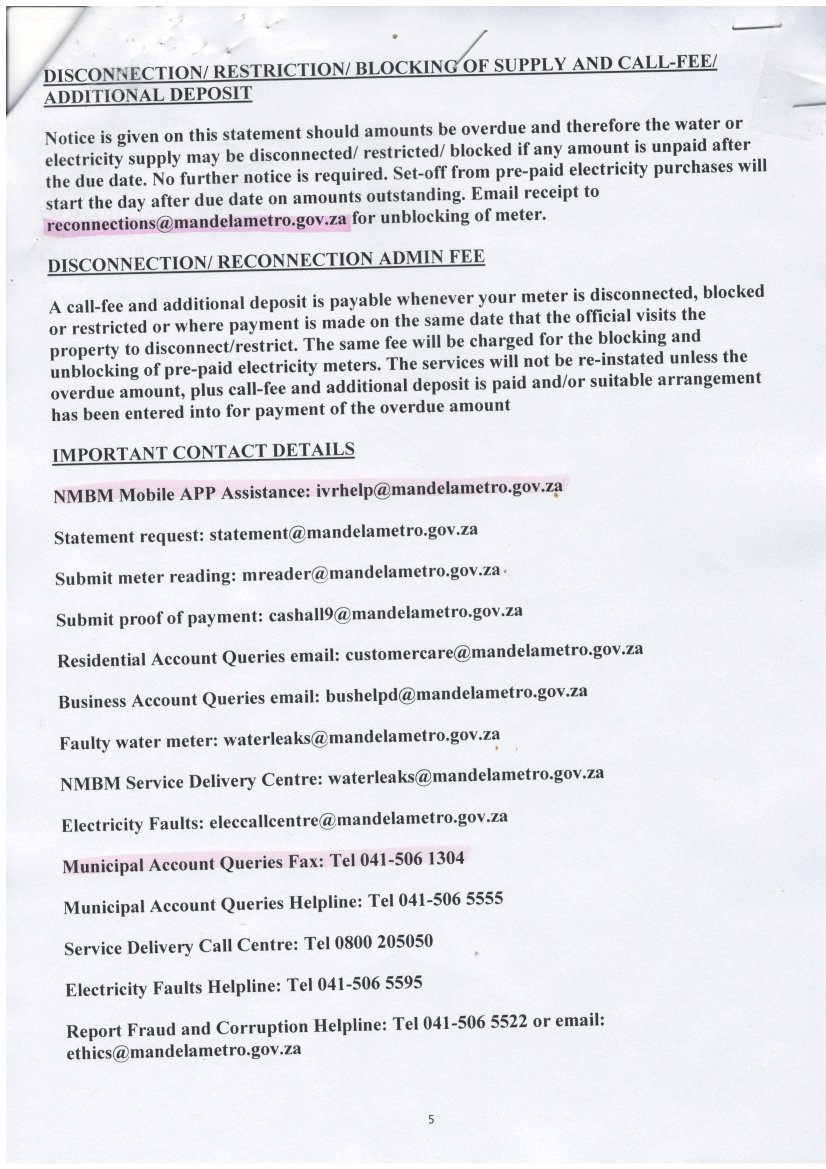
I attach hereto, some contact people at the NMBM, for your convenience, and wish you all the very best.
All Eyes on Court Bid by eThekwini Rates Boycotters
Westville Ratepayers’ Association (WRA) Chief Volunteer Asad Gaffar (51) leads the current eThekwini rates boycott which is now heading to court and all eyes are on this impending court action by eThekwini ratepayers who want legal protection for their rates boycott. The court hearing is set for 1 November and the matter isn’t likely to be concluded soon thereafter.
WRA hope that the court action will prove that the Municipal Systems Act protects disaffected residents involved in a rates boycott from punitive action by a municipality. Gaffar maintains the city cannot disconnect lights, water and other utilities.
Once residents get wind of that, he predicts a groundswell of support.
Concerned citizens have generously backed the movement. Donors have forked out at least R600,000 for legal fees. The R704,000 that “brave” boycotters have withheld is in an account with five signatories and has a host of protocols to protect it, including that its sole beneficiary is the municipality.
At present the boycotters are skating on thin ice as without a court order, they are at risk when withholding rates, as a proper dispute in terms of Section 102 of the Municipal Systems Act is required to give the boycotters a modicum of legal protection.
In the eThekwini case on 1 November, ratepayers will seek to interdict the city from cutting off water and electricity supply to rates boycotters pending finalisation of a dispute lodged by the ratepayers in June.
Background:
30 June 2023: A group of about 100 residents, including representatives from 25 ratepayer associations across the city, from Chatsworth to Springfield Park, gathered at the Westville Civic Centre for the public meeting after the Westville Ratepayers Association declared a property rates and utility bill revolt. eThekwini chief operating officer Mavuso Tshabalala and speaker Thabani Nyawose accompanied the mayor at the meeting.
Kaunda said the city had embarked on “extensive consultation with all key stakeholders” before implementing price hikes.
“Initially, the municipality proposed an electricity tariff increase of 21.91% and after listening to your complaints we tabled a revised figure of 18.49%.”
He said the budgeted increase was “conditional” on the approval of the National Energy Regulator of South Africa (Nersa). The regulator approved an increase of 15.1% for municipalities, which city spokesperson Gugu Sisilana later explained meant the city’s budgeted, conditional tariff hike increase would drop to 15.1%
The constitutional court judgment in the Liebenberg v Bergrivier Municipality matter (2013) found; “Part of paragraph 79 of the judgment reads: Local government is an important tier of public administration as any. It has to continue functioning for the common good; it, however, cannot do so efficiently and effectively if every person who has a grievance about the conduct of a public official or a governmental structure were to take the law into his or her own hands or resort to self-help by withholding payment for services rendered … It is not for the disgruntled individual to decide what the appropriate relief should be and to combine with others or take it upon himself or herself to punish the government structure by withholding payment which is due.”
At the 30 June meeting Gaffar said; “The Act [Municipal Property Rates Act of 2004] says it is illegal to withhold rates under ‘normal circumstances’ if the city is providing you with all the services, but the city was not providing all services in terms of the Act.”
The Westville Ratepayers Association says it will suspend the rates boycott if the following 11 demands are met:
- That the 2023-24 tariff be set aside
- That the 2023-24 tariff be backdated to 1 July 2023;
- The renegotiation of the 2023-24 tariff increase to make it affordable for everyone;
- Undertake a comprehensive action plan to deal with misappropriation and irregular expenditure;
- An immediate end to disconnections.
- The setting aside of rates increases on properties where residents have filed valuation appeals;
- A review of all credit agreements and a moratorium on all interest on overdue accounts;
- A simplified bill;
- Regular accurate meter reading; estimated readings must stop;
- The writing off of arrears rates owed by people over the age of 65; and
- The establishment of an oversight board comprising ratepayers and city officials within 14 days.
11 August 2023: the audit committee of eThekwini Municipality urged the metro to urgently resolve the dispute with Durban ratepayer organisations that are withholding rates payments or risk a financial crisis.
The Municipal Systems Act, 2000 at s5 requires local government, as the sphere of government closest to the people, to engage local communities in the business of government (public participation) but does not prescribe the manner in which this is to take place.
Ethekwini municipality discharges this obligation by consulting its ward committees (its own creations and therefore representative of government rather than of the public) and interpreting this consultation in terms of plans included in its Integrated Development Plan (where they remain unsullied from year to year). The community has no part to play in this system.
Podcast: Mike Wills speaks with Asad Gaffar, Westville Ratepayers Association chairperson: